Why Are Your Baseball Cards Worth Pennies When Others Sell for Millions?
Complete baseball cards value guide with current prices, grading data, and market trends. Learn which cards are worth money and where to buy/sell.
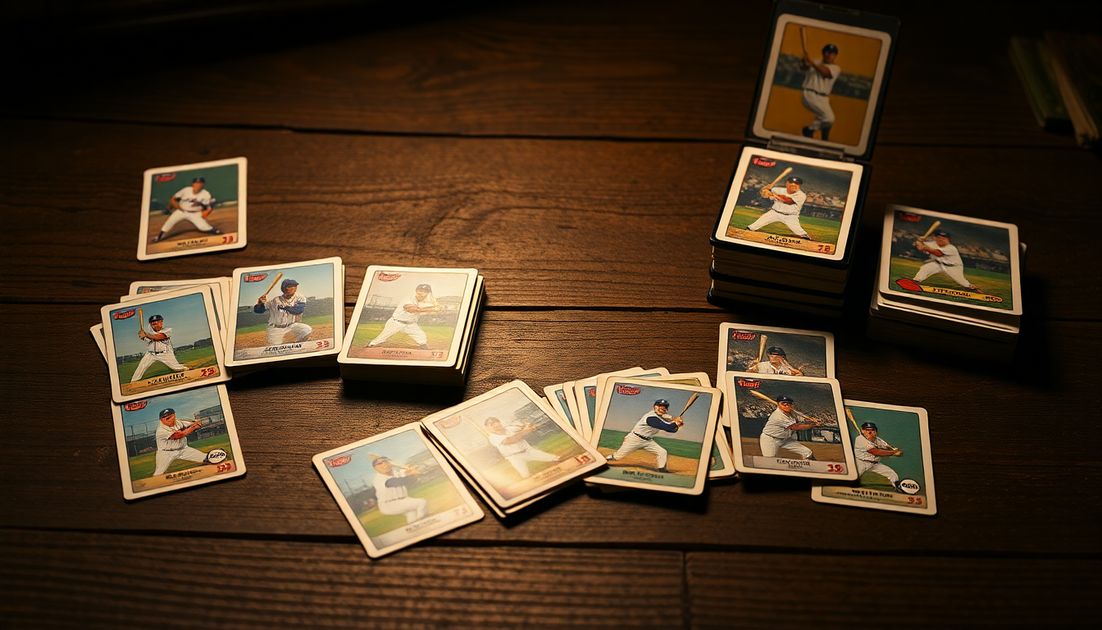
You probably have a shoebox full of baseball cards gathering dust somewhere. Maybe you collected them as a kid, or inherited them from a relative who swore they'd be worth something someday. The brutal truth? Most modern baseball cards are worth about as much as the cardboard they're printed on. But understanding baseball cards value means knowing which needles hide in the haystack—and why a 1952 Topps Mickey Mantle sold for $12.6 million while your 1991 Donruss collection won't buy you lunch.
The baseball card market operates on scarcity, condition, and cultural significance. Pre-1980 cards benefit from limited print runs and decades of attrition. Post-1986 cards suffered from massive overproduction during the "junk wax era." Modern cards (1990s-present) fight against print runs in the millions, though rookie cards of future Hall of Famers can still deliver returns.
Current market data from PSA shows over 16,000 graded 1952 Topps Mantle cards, with PSA 1s trading around $35,000 and PSA 8s hitting $750,000. Compare that to 1989 Upper Deck Ken Griffey Jr. rookies—PSA has graded over 45,000 copies, with PSA 10s selling for $2,400-$2,800 on eBay over the past 30 days.
Understanding Baseball Cards Value Through Market Segments
The baseball card market splits into distinct eras, each with different value drivers and risk profiles. Vintage cards (pre-1970) command premium prices due to genuine scarcity. The golden age (1948-1973) represents the sweet spot for investment-grade material. Modern cards require superstar rookies or ultra-rare parallels to generate meaningful returns.
Vintage Era (1900-1950): T206 Honus Wagner leads this segment at $6.6 million for a PSA 5 example. Population reports show extreme scarcity—PSA has graded only 75 total Wagner cards across all grades. Even low-grade examples fetch six figures. Other T206 cards trade for $500-$50,000 depending on player and condition. The 1933 Goudey Babe Ruth #53 PSA 8 sold for $5.2 million in 2022, establishing new benchmarks for pre-war material.
Golden Age (1948-1973): This era produces the most liquid high-value cards. 1952 Topps remains the king, with common players in PSA 8 bringing $200-$1,000. Stars like Willie Mays (#261) hit $25,000+ in PSA 9. The 1963 Topps Pete Rose rookie consistently trades above $10,000 in PSA 8, with only 1,847 copies graded at that level or higher.
Overproduction Era (1974-1993): Most cards from this period carry minimal value due to massive print runs. Exceptions include the 1975 Topps George Brett rookie (PSA 10s at $15,000), 1982 Topps Traded Cal Ripken Jr. (PSA 10s at $8,000), and 1984 Fleer Update Roger Clemens (PSA 10s at $12,000). These cards benefit from condition sensitivity—most copies show poor centering or corner wear.
Modern Rookie Card Performance Data
Recent rookie cards show mixed performance based on player development and print run management. 2001 Bowman Chrome Albert Pujols autographs peaked around $8,000 during his Cardinals prime but have settled at $3,500-$4,000 as his career winds down. Meanwhile, 2009 Bowman Chrome Draft Mike Trout superfractor sold for $3.84 million, though base autographs trade for $15,000-$20,000.
Juan Soto's 2018 Bowman Chrome rookie autograph hit $6,000 after his World Series performance but corrected to $2,800-$3,200 following his Padres trade struggles. Ronald Acuña Jr.'s 2018 Topps Chrome rookie maintains steady demand at $400-$500 in PSA 10, supported by consistent MVP-level production.
Set Registry Impact on Values
PSA's Set Registry creates artificial demand for high-grade commons, inflating prices beyond natural collecting interest. A 1972 Topps common in PSA 10 might trade for $300-$500, despite the same card in raw form selling for $5. Registry competition drives this premium, as collectors pay substantial sums to complete sets at the highest grade levels.
BGS 9.5 Black Label cards command 3-5x premiums over regular 9.5 grades due to perfect subgrades across all categories. A 2001 Bowman Chrome Albert Pujols BGS 9.5 trades for $1,200, while a Black Label 9.5 reaches $4,000-$5,000.
Baseball Cards Value Trends and Market Analysis
The baseball card market experienced unprecedented growth during 2020-2021, driven by stimulus spending, nostalgia purchases, and celebrity involvement. Gary Vaynerchuk's high-profile box breaks and Logan Paul's Pokemon crossover attention brought new money into vintage cards. This artificial demand created unsustainable price levels that have since corrected 30-50% across most categories.
Current market conditions show stabilization around 2019 price levels for most material. Vintage Hall of Famers maintain strong support, while modern cards face continued pressure from new releases and spec buying fatigue. eBay sold listings over the past 90 days confirm this pattern—1986 Fleer Michael Jordan PSA 10s peaked at $350,000 in early 2021 but now trade for $180,000-$200,000.
Price Movement Catalysts: Hall of Fame announcements create temporary spikes. Derek Jeter's 2020 induction drove his 1993 SP Foil rookie from $8,000 to $15,000 in PSA 10, though it's since settled at $10,000-$12,000. Death announcements similarly impact values—Hank Aaron cards jumped 40% following his passing in January 2021.
Anniversary years generate collecting interest. The 70th anniversary of the 1952 Topps set created renewed focus on vintage material throughout 2022. Topps capitalized by releasing anniversary sets and limited print runs, though these modern products carry speculative risk.
International Market Dynamics: Japanese interest in American baseball cards has grown substantially. Shohei Ohtani's success drives demand for vintage angels and modern rookie cards among Japanese collectors. Ichiro Suzuki's 2001 rookie cards maintain premium pricing in Japanese markets, with his 2001 Bowman Chrome autograph trading for $2,000-$2,500 compared to $1,200-$1,500 domestically.
Condition Sensitivity and Grading Premiums
Baseball cards show extreme condition sensitivity compared to other collectibles. A 1952 Topps Willie Mays in PSA 6 trades for $4,000-$5,000, while a PSA 9 reaches $40,000-$50,000. This 10x multiple reflects the rarity of high-grade vintage material and the prestige associated with perfect centering and corners.
Grading costs continue rising, with PSA charging $150+ for vintage submissions during peak demand. Factor in shipping, insurance, and time value, and the break-even threshold sits around $300-$400 for most cards. Lower-value material rarely justifies grading costs unless you're completing registry sets or believe the card will grade higher than raw condition suggests.
Authentication Concerns: Doctored cards plague the vintage market. Trimming, recoloring, and corner reconstruction are common issues. PSA and BGS have improved detection methods, but altered cards still slip through. Always buy from reputable dealers and examine edges carefully—uneven borders or suspicious color saturation indicate potential alterations.
Where to Buy and Sell Baseball Cards for Maximum Value
Different marketplaces serve different segments of the baseball card market. Understanding where to buy and sell each type of card directly impacts your returns and risk exposure.
eBay: Dominates the baseball card marketplace with the largest selection and most competitive pricing. Best-in-show auctions for high-end vintage cards regularly exceed auction house results. Recent sales show strong liquidity across all price points—from $5 commons to six-figure Hall of Fame rookies. Watch for shill bidding on high-value items and always check seller feedback for authenticity concerns.
Completed listings provide the most accurate pricing data. Filter by "Sold" and narrow timeframes to 30-90 days for current market trends. Account for Best Offer acceptances, which typically run 10-15% below asking prices.
COMC (Check Out My Cards): Offers consignment services with professional photography and detailed condition descriptions. Their "Challenges" feature creates buyer competitions for specific cards, often driving prices above market rates. Commission structure ranges from 5-20% depending on sale price, making it cost-effective for higher-value items.
Heritage Auctions: Handles the finest vintage material with extensive authentication and condition reporting. Recent auctions achieved strong results for museum-quality pieces—a 1933 Goudey Babe Ruth PSA 8.5 hit $4.2 million in their January 2023 sale. Buyer's premiums run 20-25%, but the clientele pays up for provenance and condition certainty.
Modern Card Marketplace Dynamics
Whatnot: Live streaming auctions have grown rapidly for modern cards and boxes. Prices often exceed eBay comps due to FOMO bidding and entertainment value. Sellers benefit from reduced fees and instant payment, while buyers get authentication guarantees and return policies.
TCGplayer: Primarily serves the gaming card market but carries baseball card inventory from major dealers. Pricing tends to run 5-10% above eBay due to seller reputations and return policies. Best for raw modern cards and complete sets.
Facebook Groups: Private groups like "Vintage Baseball Cards BST" and "High End Baseball Card Sales" offer direct dealer-to-collector sales. Prices typically beat eBay after factoring fees, but authentication relies on seller reputation. Exercise extreme caution with high-value transactions and always use PayPal Goods & Services for protection.
Investment Strategy and Risk Management
Successful baseball card investing requires understanding market cycles, player performance trajectories, and set scarcity. Vintage Hall of Famers offer the safest store of value, while modern rookies carry higher upside but substantial downside risk.
Core Holdings Strategy: Build around 1952 Topps, 1955 Topps, and 1967 Topps in PSA 7-8 condition. These sets maintain consistent demand from both investors and set builders. Target $2,000-$10,000 per card to balance liquidity and appreciation potential.
Speculation Approach: Focus on rookie cards of current superstars in their first 3-5 seasons. Mike Trout, Ronald Acuña Jr., and Juan Soto represent different risk/reward profiles. Buy multiple copies across different parallel sets and conditions to diversify grading risk.
Contrarian take: Modern parallels numbered to 10 or fewer copies often trade below vintage common cards in similar condition. A 2022 Topps Chrome Julio Rodríguez Gold Refractor #/50 might cost $300-$500, while a 1972 Topps common in PSA 9 runs $200-$400. The modern card offers significantly higher upside if Rodríguez develops into a perennial All-Star.
Portfolio Allocation: Vintage cards should comprise 60-70% of serious collections due to established scarcity and proven track records. Modern rookies merit 20-30% allocation for growth potential. Avoid overexposure to any single player or set—even Mickey Mantle cards declined during certain periods.
Exit strategies matter as much as entry points. High-grade vintage cards maintain strong auction demand, while modern material often requires patience for the right buyer. Plan holding periods of 5-10 years for meaningful appreciation, though exceptional cards can deliver shorter-term returns during market cycles.